How to Write History that People Want to Read
My Summary
Key takeaways
References to Explore
Leopold von Ranke - on source-based history, implemented the seminar teaching method, first to establish a historical seminar, influence fostered claims to historical objectivity and scientific validity
Fritz Stern, ed., The Varieties of History: From Voltaire to the present (Cleveland: Meridian, 1966), 227–45.
- criticised historians who forget that historical writing is a creative act, which must involve imaginative sympathy to make the past intelligible to the present. The greatest sin in historical composition was, in his view, to pretend that ‘the facts’ were being allowed to ‘speak for themselves’. (p. 8)
J.H. Hexter, ‘The rhetoric of history,’ History and Theory 6, no. 1 (1967): 3–13. A longer version appeared in J.H. Hexter, Doing History (London: George Allen & Unwin, 1971).
🔥 Arthur Marwick, The Nature of History (London: Macmillan, 1970).
Marc Bloch, The Historian's Craft
Nancy Shoemaker, ed., Clearing a Path: Theoretical approaches to the past in Native American studies (New York: Routledge, 2002)
Nancy Shoemaker, ed., Negotiators of Change: Historical perspectives on Native American women (New York: Routledge, 1995)
Peter Nabokov, A Forest of Time: American Indian ways of history (Cambridge: Cambridge University Press, 2002).
Bibliography: Curthoys, Ann, and Ann McGrath. 2011. How to Write History That People Want to Read. London: Palgrave Macmillan UK. https://doi.org/10.1007/978-0-230-30496-3.
Authors:: Ann Curthoys, Ann McGrath
Tags:
Collections::
content: "@curthoysHowWriteHistory2011" -file:@curthoysHowWriteHistory2011
Highlights and Notes
Kindle Notes
Historians are interested in the whole human past. We want to people that past with living, breathing individuals, as if they lived only yesterday, as if we had known them. (1)
Imported on 2025-04-29 at 09:20
💬 General
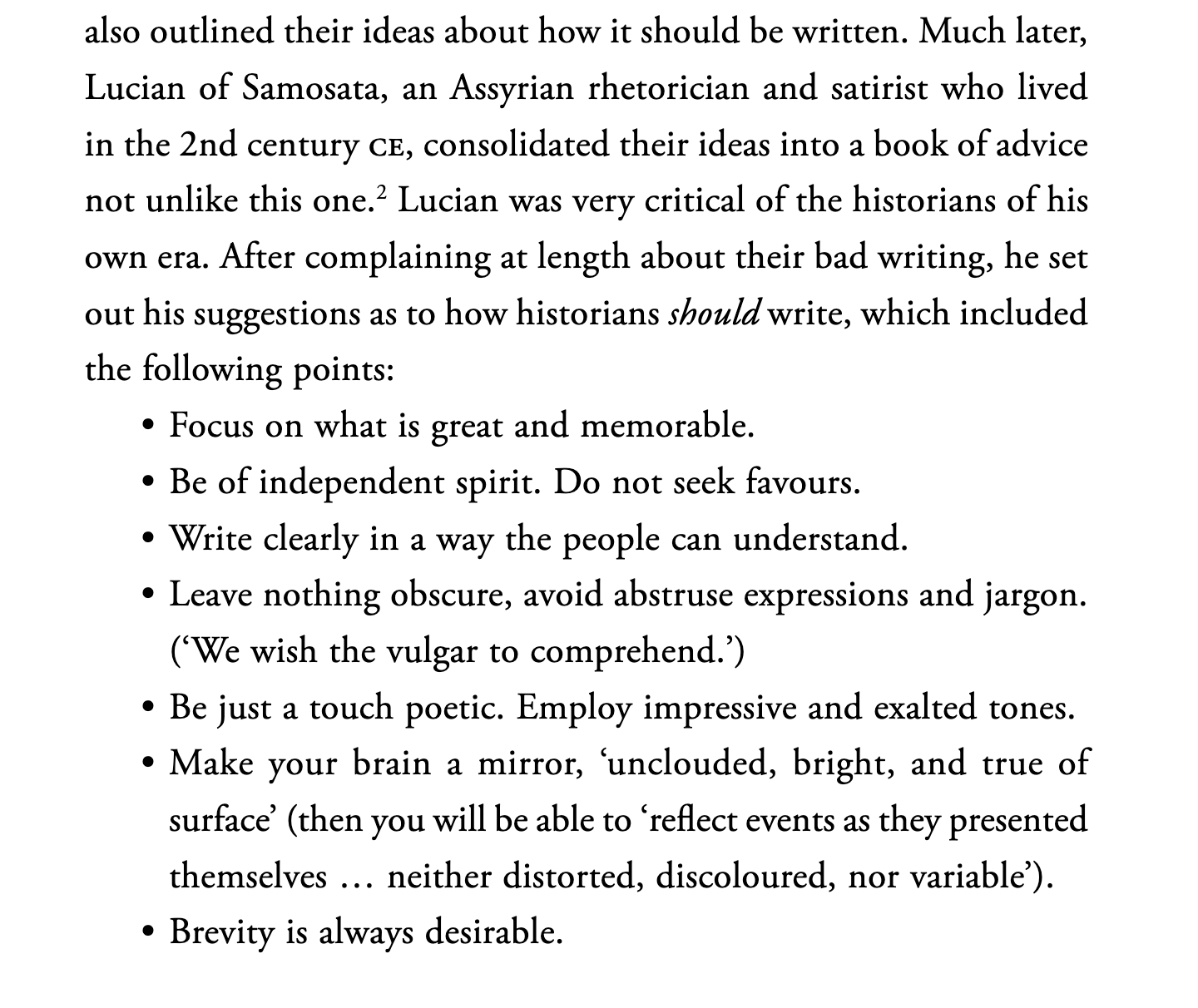
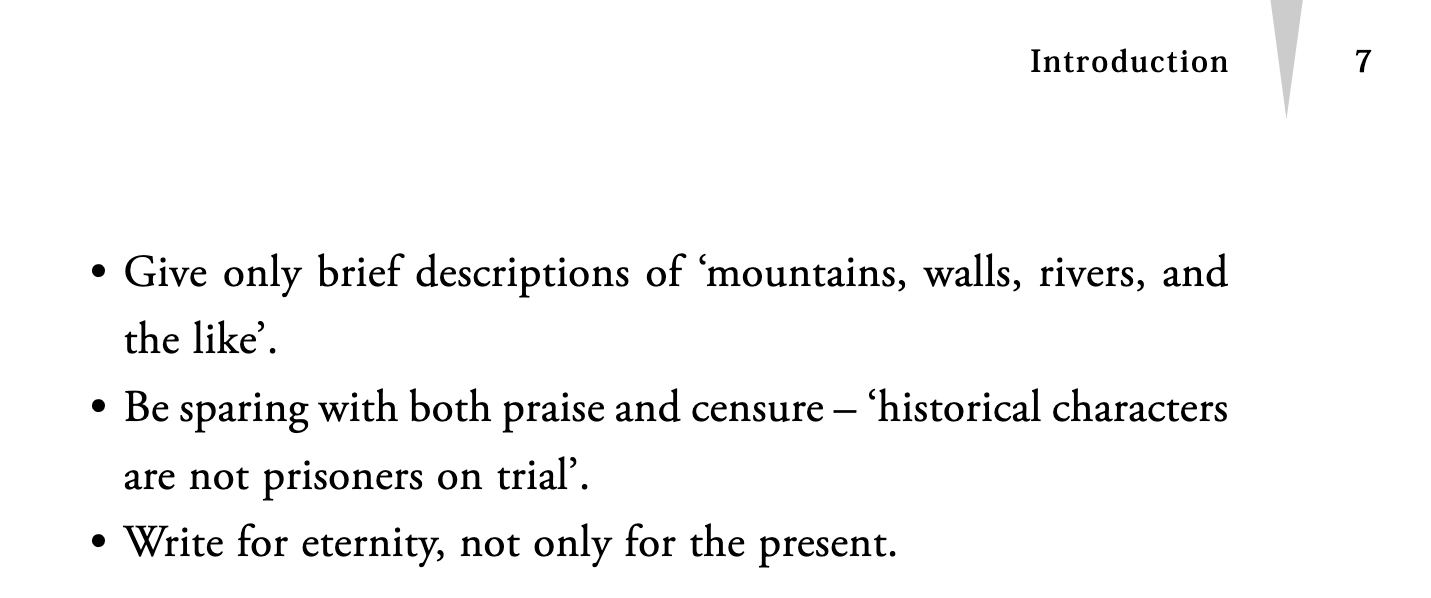
Imported on 2025-04-29 at 09:40
🧩 Methodology, Method, Framework
- £ We ponder the lives of those who preceded us, who helped make us, in some small way, who and what we are. (p. 3)
- £ We emphasise the writing of historical narrative. Most historians agree that narrative is essential to history, but feel a little uncertain of how to actually write it. One of the reasons for this uncertainty is that in most historical training the emphasis is on argument, debate or the critique of another’s work. (p. 6)
- £ What students are learning is worthwhile, but they don’t learn how to write narrative. (p. 6)
💬 General
- & Scholarly histories often examine the shameful as well as the proud moments, and can debunk popularly held and much-cherished myths. (p. 4)
- & Inside every historian, we think, is a popular communicator trying to get out. (p. 5)
🗯️ Important
- ~ Historians are interested in the whole human past. We want to people that past with living, breathing individuals, as if they lived only yesterday, as if we had known them. (p. 1)
- ~ History can explain the world and place us in a better position to deal with the future. (p. 2)
- ~ We know that history can live. Indeed, it can get up and do a tap dance. It can be a means of revelation – of the greatest stories about the world, of wonder and surprise at human foibles, of human achievement. It can reveal the complexity of that which we thought was simple, and clarify something we thought we would never be able to understand. It can transform our understandings and teach us to think from other perspectives – whether of culture, class, lifestyle or gender. (p. 2)
- ~ Some people think of history as just a jumble of facts, or perhaps a list of dates with events attached. Historians know differently; they love linking complex cultural and social contexts with the richness of the biographies of influential or ordinary individuals; they love to ponder how the historical legacies with which we are endowed were shaped. (p. 3)
- ~ history is about somebody else’s present time. It wasn’t always the past. (p. 3)
- ~ Irreverence is a great virtue of the young, and we need lots of it if we are to challenge accepted explanations for the past. (p. 3)
- ~ What students are learning is worthwhile, but they don’t learn how to write narrative. (p. 6)
Imported on 2025-04-29 at 09:57
📇 Secondary Citation
-
- Herbert Butterfield, in his now classic book, The Whig Interpretation of History (1931), criticised historians who forget that historical writing is a creative act, which must involve imaginative sympathy to make the past intelligible to the present. The greatest sin in historical composition was, in his view, to pretend that ‘the facts’ were being allowed to ‘speak for themselves’.5 (p. 8)
Imported on 2025-04-29 at 14:04
🧩 Methodology, Method, Framework
- £ A number of historians responded to the philosophers by insisting that historians did have rigour in their work, but of a different kind from that we would expect in philosophy or natural science. Historians had their own modes of narration and analysis, and their own rules and protocols to guide their work. (p. 8)
- £ Postmodernism stressed the importance of the historian as narrator in his or her own texts, and suggested that we should be always selfconscious and self-reflexive about what we are doing, about how we are constructing our texts as history. (p. 9)
- £ historians regularly and unwittingly use the techniques of fiction to narrate their accounts of the past. (p. 9)
📇 Secondary Citation
-
- The American historian J.H. Hexter took up the challenge in an essay in 1967.8 (p. 9)
-
- British historian Arthur Marwick, in The Nature of History (1970), (p. 9)
-
- American historian of ideas, Hayden White (p. 9)
📌 Statistics and info
- % The sharp criticisms of historians by philosophers of history in the 1960s – criticisms of the historians’ typically weak explanations and forms of analysis, and of their tendency to imply causation without rigorously examining the relationship between events7 – led to a flurry of articles and books of historical advice in the late 1960s and early 1970s. (p. 8)
- % A number of historians responded to the philosophers by insisting that historians did have rigour in their work, but of a different kind from that we would expect in philosophy or natural science. Historians had their own modes of narration and analysis, and their own rules and protocols to guide their work. (p. 8)