The Economy of Manichean Allegory
My Summary
Manichean means to view matters in terms of simple black and white. JanMohamed posits that the Manichean allegory in colonial literature provides a convenient (economical) trope or framework for colonisers to retain a mask that hides the complexity and tensions of the colonial mission.
My Takeaways
- colonialist literature wants to operate in black and white
- identity vs difference, but actually both
- colonialism in terms of identity
- colonialism in terms of difference
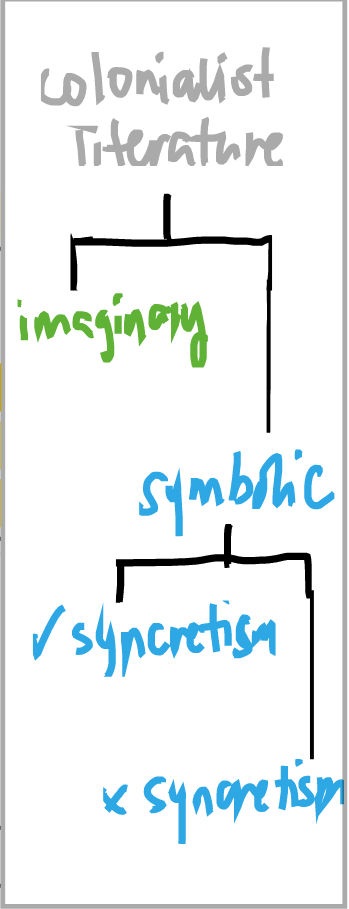
- 'imaginary' colonialist literature - fetishization is an excellent illustration/tool here, but careful reading of the text will show the 🪴 contradictions of colonial description
- 'symbolic' colonialist literature
References to Explore
Bibliography: Janmohamed, Abdul. 1995. “The Economy of Manichean Allegory.” In The Post-Colonial Studies Reader, edited by Bill Ashcroft, Gareth Griffiths, and Helen Tiffin. London and New York: Routledge.
Authors:: Abdul Janmohamed, , Gareth Griffiths, Helen Tiffin
Tags: #ObsCite
Collections::
Abstract
Citations
content: "@janmohamedEconomyManicheanAllegory1995" -file:@janmohamedEconomyManicheanAllegory1995
Highlights and Notes
Imported on 2025-04-25 at 08:12
💬 General
- & the colonizers invariable assumption about his moral superiority means that he will rarely question the validity of either his own or his society’s formation and that he will not be inclined to expend any energy in understanding the worthless alterity of the colonized. (p. 18)
- & instead of seeing the native as a bridge toward syncretic possibility, it uses him as a mirror that reflects the colonialist’s self-image. (p. 19)
- & in the ‘imaginary’ colonialist realm, to say ‘native’ is automatically to say ‘evil’ and to evoke immediately the economy of the manichean allegory. (p. 19)
- & Writers of ‘symbolic’ texts, on the other hand, are more aware of the inevitable necessity of using the native as a mediator of European desires. (p. 19)
- & They are willing to examine the specific individual and cultural differences between Europeans and natives and to reflect on the efficacy of European values, assumptions, and habits in contrast to those of the indigenous cultures. (p. 19)
- & every desire is at base a desire to impose oneself on another and to be recognized by the Other, (p. 20)
- & exercising his assumed superiority, he destroys without any significant qualms the effectiveness of indigenous economic, social, political, legal, and moral systems and imposes his own versions of these structures on the Other (p. 20)
- & such images are used at random and in a self-contradictory fashion (p. 21)
- & Since Tanawe is too young to challenge colonialism, she can be depicted in a benign manner, and the narrator can draw moral sustenance from the generosity of his portrayal. But the adult Kolus’ desire to become Christians threatens to eliminate one of the fundamental differences between them and the Europeans; so the narrator has to impose a difference (p. 21)
- & the imperialist is not fixated on specific images or stereotypes of the Other but rather on the affective benefits proffered by the manichean allegory, which generates the various stereotypes (p. 21)
- & allow the writer to transform social and historical dissimilarities into universal, metaphysical differences (p. 22)
- & If the differences between the Europeans and the natives are so vast, then clearly, as I stated earlier, the process of civilizing the natives can continue indefinitely. (p. 22)
- & his success in comprehending or appreciating alterity will depend on his ability to bracket the values and bases of his culture (p. 22)
- & not unidirectional: the ideology does not simply determine the fiction (p. 23)
- & Rather, through a process of symbiosis, the fiction forms the ideology by articulating and justifying the position and aims of the colonialist (p. 23)
- & Troubled by the nagging contradiction between the theoretical justification of exploitation and the barbarity of its actual practice, it also attempts to mask the contradiction by obsessively portraying the supposed inferiority and barbarity of the racial Other, thereby insisting on the profound moral difference between self and Other (p. 23)
- & by permitting an obsessive, fetishistic representation of the native’s moral inferiority, the allegory also enables the European to increase, by contrast, the store of his own moral superiority (p. 23)
🗯️ Important
- ~ Faced with an incomprehensible and multifaceted alterity, the European theoretically has the option of responding to the Other in terms of identity or difference. (p. 18)
- ~ Genuine and thorough comprehension of Otherness is possible only if the self can somehow negate or at least severely bracket the values, assumptions, and ideology of his culture (p. 18)
- ~ Instead of being an exploration of the racial Other, such literature merely affirms its own ethnocentric assumptions; instead of actually depicting the outer limits of ‘civilization,’ it simply codifies and preserves the structures of its own mentality. (p. 19)
- ~ Thus the ideological function of all ‘imaginary’ and some ‘symbolic’ colonialist literature is to articulate and justify the moral authority of the colonizer and—by positing the inferiority of the native as a metaphysical fact—to mask the pleasure the colonizer derives from that authority (p. 23)
📇 Secondary Citation
-
- we must examine them in juxtaposition to domestic English fiction and the anglophone fiction of the Third World (p. 23)
📌 Statistics and info
Image (p. 19)